The Color That Closed the Retailer: Inside One Aluminum Enclosure's Second Chance
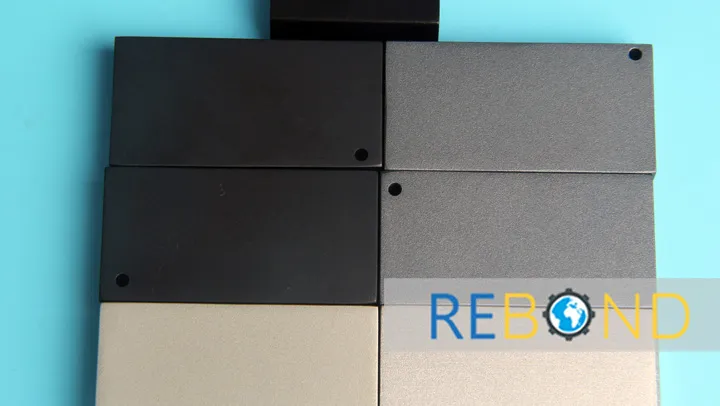
Photo: anodized aluminum enclosure samples color finish manufacturing, via www.rebondtech.com
The product worked. The margins worked. The pitch deck worked. And yet, in a category review meeting at a major American retail chain, the prototype sat on the table looking like a discount-shelf item — not because of anything the marketing team could fix, but because of how the aluminum caught the fluorescent light.
For US product teams, especially in consumer hardware, the distance between a shelf placement and a rejection letter is often measured in microns. Surface finishing — anodize dye lots, bead-blast media, laser etch depth — reads as a cosmetic footnote in most sourcing spreadsheets. Retail buyers read it as the product.
Where the Prototype Fell Apart
The brand in question — a mid-sized designer of smart home accessories, selling direct-to-consumer with respectable traction — had been sourcing its aluminum enclosures from a low-cost offshore supplier. The parts were dimensionally correct. The anodizing was, by spec, Type II, clear with a black dye. But spec sheets don't capture what a buyer's eye captures: a slightly orange-tinted black, a sheen that read as painted rather than integral, and dye consistency that drifted between production batches.
Under the even, unflattering lighting of a retail environment, those drifts compound. A buyer handling three sample units side by side sees three slightly different products. In retail evaluations, that inconsistency is fatal — it signals a supplier problem the retailer will inherit.
The team's first instinct was to redesign the enclosure. Their manufacturing partner in Kanagawa, brought in during a parallel sourcing review, suggested something less expensive: change the surface, not the part.
The Finish as a Sourcing Decision
What followed was a two-week finishing study that most US procurement teams would never schedule. The Japanese supplier produced a matrix of samples: Type II versus Type III hard anodize, matte bead-blast textures at two media grades, a proprietary two-step electrolytic dye that produces a deeper, more neutral black, and laser etching tuned for legibility under low light.
The critical point for American buyers: none of this was framed as a favor or an upcharge negotiation. It was treated as engineering. Surface treatment specifications in Japanese shops are typically documented with the same rigor as dimensional tolerances — dye bath chemistry, sealing method, and color measurement by spectrophotometer, with Delta-E values recorded per batch.
That documentation matters commercially. When the brand re-presented to the retailer, it could show batch-to-batch color data alongside the samples. The buyer wasn't being asked to trust a promise; the consistency was on paper.
What Changed on the Line
The winning combination was unglamorous: a fine bead-blast before anodizing, a deeper electrolytic black instead of organic dye, and a repositioned laser etch that replaced a silkscreened logo. Unit cost rose by roughly four percent. Perceived value at retail rose considerably more.
Three details worth noting for any team re-evaluating a finishing supplier:
- Blasting before anodizing, not after. Sequencing determines whether texture survives the anodic layer. Shops that blast last produce a sheen that dulls with handling.
- Electrolytic versus organic dyes. Organic dye blacks fade and shift hue under UV and abrasion. Two-step electrolytic color costs more and holds far longer — a distinction rarely volunteered unless asked.
- Etch depth and font choice. A laser mark that survives handling and cleaning reads as durability. A mark that wears off in month three reads as a counterfeit.
The Broader Lesson for US Buyers
Retail category reviews in the US are visual events. Products are handled, compared, and photographed under lighting no engineering lab replicates. A finish that passes a spec sheet can still fail a shelf test.
The practical takeaway is procedural, not aesthetic. Treat surface finishing as a specification with measurable acceptance criteria — color values, texture grades, abrasion and lightfastness tests — and ask prospective suppliers to demonstrate batch consistency, not just a golden sample. Suppliers who respond with spectrophotometer data and process documentation are telling you something about everything else they make.
The brand landed the retail account in the second review round. The enclosure design never changed. The color did — and in consumer hardware, the color is often the first thing a buyer actually buys.