The Building Is a Machine Too: Inside the Climate Control Behind Japan's Tightest Tolerances
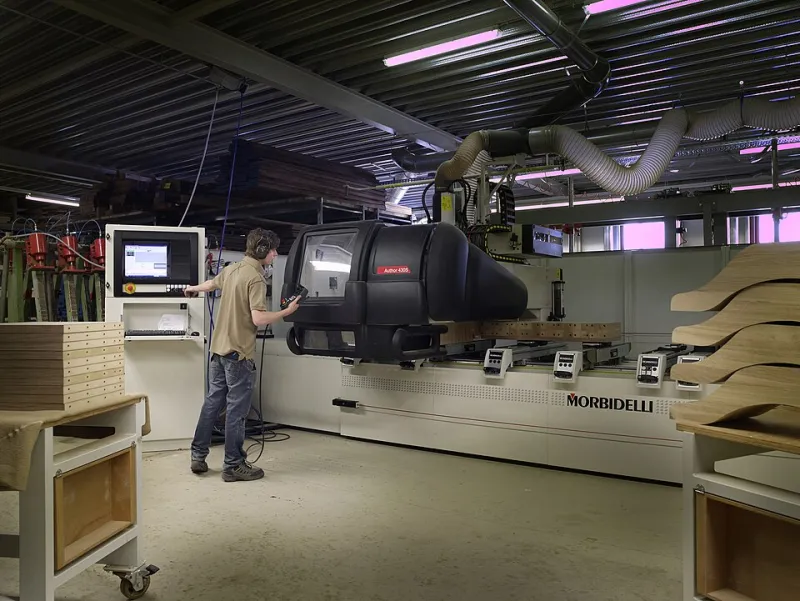
Photo: Elma Verhouden, Public domain, via Wikimedia Commons
When American procurement teams evaluate a Japanese supplier, the checklist usually follows a familiar script: machine list, calibration certificates, ISO registrations, sample parts. All of that matters. But after two decades of walking factory floors from Nagano to Niigata, we've come to believe the most revealing question is one almost nobody asks: what is the building doing for your parts?
The answer separates suppliers who hold a tolerance from those who merely aim at one.
Identical Machines, Different Factories
Consider a scenario that plays out more often than buyers realize. Two workshops, forty kilometers apart, both running the same model of vertical machining center, both staffed by experienced hands, both quoting a tight-tolerance aluminum housing for a medical device customer. One delivers parts that drift within a week of production; the other holds tenths across a six-month run.
The difference is rarely the CNC. Modern machining centers from the same production line are, for practical purposes, interchangeable. What is not interchangeable is the thermal environment they live in.
Metal expands and contracts with temperature. A steel spindle heats as it runs; the machine column absorbs warmth from afternoon sunlight through a window; a draft from a loading door shifts ambient temperature by several degrees. Each of these forces is invisible on a spec sheet, and each shows up in your part dimensions. A shop that ignores them is asking its operators to fight physics with compensation tables. A shop that manages them gives its machines a stable world to work in.
What Serious Environmental Control Looks Like
Walk into a Japanese precision workshop that takes this seriously and the first thing you notice is what you don't notice: no temperature swings, no blasts of HVAC air blowing across the machines, no sunlit patches of floor moving across the worktables through the day.
The specifics vary, but the patterns are consistent.
Temperature discipline. Many precision shops hold the machining hall at 20°C (68°F) — the international reference temperature for dimensional measurement — with swings kept to a fraction of a degree. Some go further, staging parts in the inspection room overnight so they reach the same temperature as the measuring equipment before verification. Skipping that soak time can turn a good part into a rejected one on paper alone.
Humidity as a materials issue. Humidity control isn't only about rust prevention, though that matters for steel stock and tooling. Hygroscopic materials — certain engineering plastics and composites — change dimension with moisture content. A shop that tracks humidity is a shop that has been burned before and learned.
Vibration isolation. The grinding shop three doors down, the delivery truck at the loading dock, the press brake in the next bay — all of it transmits through a concrete slab. Serious workshops either separate vibration-sensitive processes into their own foundations or isolate the equipment itself. If your parts involve fine surface finishes or optical-grade flatness, this is invisible infrastructure worth paying for.
The floor plan as a strategy. Watch where heat sources sit relative to inspection areas. In the best shops, coordinate measuring machines live in temperature-controlled rooms away from wash stations and compressors, and material staging follows a deliberate path that minimizes thermal shock as parts move from cutting to measuring.
None of this appears on a machine list. All of it appears on a CMM report over time.
The Questions Worth Asking Before You Sign
You don't need an engineering degree to probe this. You need better questions. Before awarding your next precision contract, ask the supplier:
- What is the temperature range in the machining area over a 24-hour cycle, and how is it logged?
- Are parts temperature-soaked before final inspection, and for how long?
- How does the shop handle seasonal transitions — Japan's humid summer and dry winter are more extreme than many US regions expect?
- Where are the CMMs located relative to heat-generating equipment?
- Has the building been modified for vibration isolation, or is it a general-purpose industrial shell?
The quality of the answers matters as much as their content. A supplier who responds with logged data and a floor plan is telling you something about their culture of measurement. A supplier who seems puzzled by the question is telling you something too.
Why This Should Reshape Your Supplier Audits
For US buyers, the implication is straightforward: stop auditing only the machines and start auditing the building. On your next site visit — or your next remote audit — spend ten minutes simply observing the environment. Feel for drafts. Look for thermometers and humidity loggers mounted on the walls. Notice whether inspection happens in a dedicated room or at a bench beside a busy aisle.
The economics favor the buyer who understands this. Environmental infrastructure is expensive to add and impossible to fake in a sample run of fifty pieces. A supplier who invested in it years ago, before you arrived, has embedded a consistency advantage into their cost structure that no amount of operator skill can replicate in a lesser building.
And it reframes pricing conversations. When one Japanese quote runs higher than a domestic equivalent, the delta often funds exactly this kind of invisible engineering — the insulation, the staging protocols, the isolated foundations. You are not paying for prestige. You are paying for the conditions under which a tolerance becomes a promise rather than a hope.
The next time two suppliers offer identical equipment lists, remember: the machine is only half the system. The room around it is the other half. Ask about both.